 Key Industries & Bonded Zone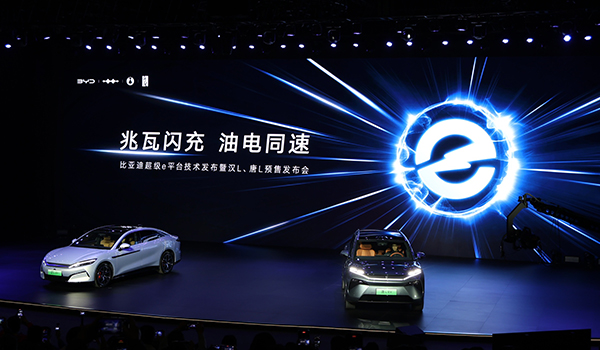
BYD’s “Super e-Platform” for EVs supports peak charging speeds of 1,000 kilowatts, allowing EVs to power up as quickly as refueling a petrol car. Photo by Zhen Jianhong
The new energy and intelligent connected vehicle (ICV) industry is one of the three leading industries in Pingshan. Relying on the national-level new energy automobile base, Pingshan focuses on key areas such as autonomous driving and intelligent connectivity. In 2022, the National Development and Reform Commission and the Ministry of Commerce proposed to support Pingshan to build a national-level ICV test zone, a product quality inspection and testing center and an Internet of Vehicles pilot zone. Test and inspection reports are mutually recognized within national platforms, to promote the integration and development of new energy and ICVs, and to form an industrial agglomeration effect, with the scale of the industry growing continuously.
1. Output value
Pingshan is home to hundreds of whole-vehicle and car part manufacturing, autonomous driving and new energy vehicle (NEV) companies, such as BYD and Skywell New Energy, CATARC, CAERI, Ampron, AutoX, DiPi Intelligent Mobility, Neolix, NavInfo and CiDi. In 2024, the output value of new energy and ICV industry in the district exceeded 400 billion yuan.
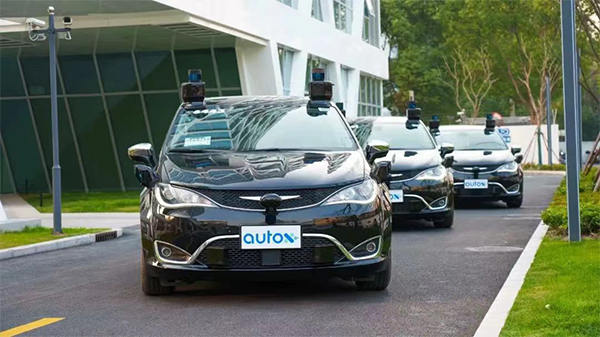
AutoX robotaxis run in Pingshan. Photo courtesy of AutoX
Pingshan also hosts platforms such as the Shenzhen Automotive Research Institute of Beijing Institute of Technology, Shenzhen Future Intelligent Network Transportation System Industry Innovation Center, and the Shenzhen Intelligent Connected Vehicle Industry Association.
As one of the city’s few regions with a complete NEV industrial chain, Pingshan has advantages in the new-energy storage development. A new-energy storage industry cluster led by FinDreams Battery, Capchem, Katop, Haoneng and Hailei and a complete industry chain of battery materials, batteries, battery production equipment and charging equipment have been formed. Pingshan is laying out the next-generation industry 4.0-level solid-state lithium-ion batteries industry chain development.
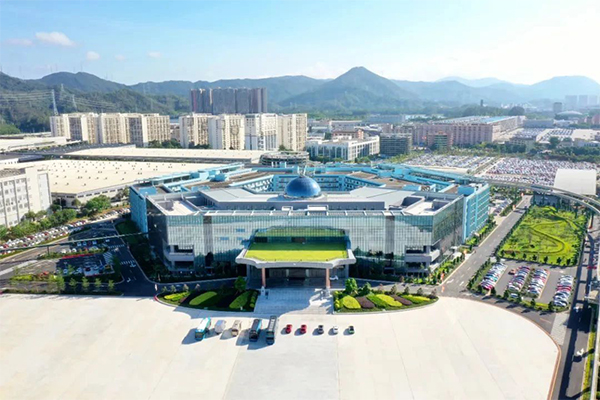
The BYD headquarters in Pingshan District.
2. Innovative platforms
Innovation platforms in Pingshan include the Greater Bay Area Automobile Technology Association, the Shenzhen Future Intelligent Network Transportation System Industry Innovation Center, Shenzhen Intelligent Connected Vehicle Industry Association, and the Intelligent Connected Vehicle Industry Service Center, as well as the Shenzhen Automotive Research Institute of Beijing Institute of Technology, CATARC Technology Co. Ltd., CAERI Shenzhen Technology Co. Ltd., BYD Toyota EV Technology Co. Ltd. and the Yupeng New Energy Vehicle Test and Research Co. Ltd.
3. Infrastructure
Pingshan is constructing the GBA’s only closed test site for ICVs. With a total investment of 800 million yuan, the site, located in Shijing Subdistrict, covers an area of 43 hectares. The site focuses on cutting-edge ICV technologies, providing testing venues and equipment services, as well as providing guarantees for Shenzhen ICV operation access and license testing in the city, Pingshan’s whole-region ICV openness management, and major industry activities. Based in Shenzhen and serving Hong Kong and Macao, it provides strong support for the construction of smart cities in Hong Kong and Macao, providing strong support for the integrated development of the automotive industry cluster in the GBA.
The test site is divided into six major areas: a high-speed test area, advanced driver-assistance system (ADAS) test area, urban test area, flexible test area, ramp test area and urban parking test area. The six areas give full consideration to the needs of automobile enterprises’ independent R&D, meeting requirements for going abroad and obtaining ICV operation access in Shenzhen, as well as combining the Hong Kong and Macao traffic scenarios. At the same time, the V2X (vehicle-to-everything) test elements are also considered.
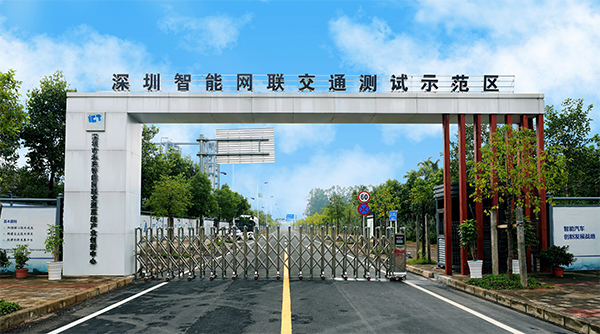
Shenzhen Intelligent Connected Traffic Test Demonstration Zone in Pingshan.
Pingshan is covered with 5G infrastructure. To accelerate the vehicle-to-everything, 5G, Beidou and other industrial technological innovations and applications, Pingshan is the first district in the city to carry out the vehicle-road-cloud network construction throughout an entire district, integrating key road intersections (points) with intelligent connectivity in the district, to create a leading intelligent networking environment in the country.
4. Industrial policies, fund
In December 2020, Pingshan District rolled out the city’s first district-level supportive policies for ICV development. By supporting enterprises’ settlement, testing, rental, R&D and production, the policies help enterprises in innovation and development. At present, due to new changes in the industry and new demands of enterprises, the policies are being further revised and improved. Additionally, the Implementation Measures for the Training, Introduction and Management of Talents in the NEV and ICV Industry in Pingshan was implemented Nov. 10, 2022.
The Shenzhen NEV industrial fund, with 5 billion yuan in the first phase, was launched in Pingshan on Sept. 26, 2023 to further support the city’s NEV and ICV industrial development.
5. Industrial spaces
The Pingshan New Energy Automobile Industrial Park is located in the National New Energy Industry Base. Covering an area of approximately 70,800 square meters with a total construction area of more than 510,000 square meters, the park includes production plants, R&D offices, apartments, restaurants and commercial facilities. It is home to a group of new energy enterprises such as BYD, Capchem, Ebusbar and Skywell.
By introducing the Shenzhen Automotive Research Institute of Beijing Institute of Technology and leveraging its advantages in advanced technology and high-end talents, the industrial park provides strong support for Pingshan’s development in the NEV, ICV and new energy storage industries.
The park includes China’s first smart prefabricated high-rise vertical factories which provide super-high load capacity and space for equipment used for manufacturing NEVs. Additionally, vertical and on-site logistics are also taken into consideration.
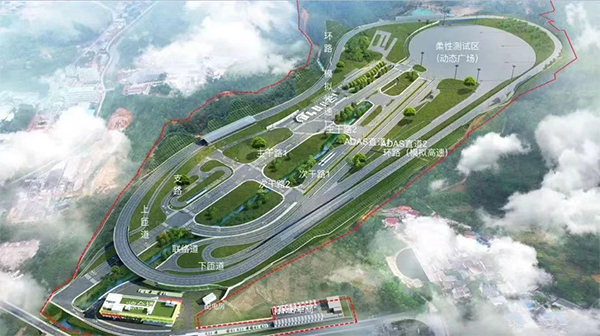
Shenzhen Intelligent Connected Traffic Test Demonstration Zone in Pingshan.
6. Demonstration
Pingshan has opened its whole region for ICV enterprises to explore multiple application scenarios, including the constructing of a large-scale testing and commercial application environment for diverse scenarios such as manned transportation, logistics, and environmental sanitation, forming a highly collaborative development system of “human-vehicle-road-cloud.”
Pingshan has attracted more than 10 companies including Baidu, AutoX and Meituan to carry out demonstrations in multiple scenarios and has been gradually exploring commercialization applications. The district has opened more than 10 demonstration routes for driverless buses, minibuses, robotaxis, delivery vehicles and retail store delivery. As of August 2023, the total operating mileage has exceeded 700,000 kilometers, which provides rich practical experience for managing ICVs in Pingshan.
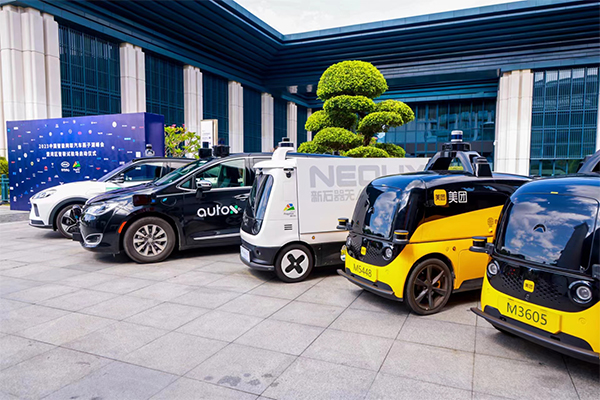
Intelligent connected vehicles in Pingshan.
7. Whole-region openness
Pingshan took the lead in the city in proposing the opening of the whole region for ICVs. In June 2022, Shenzhen released China’s first regulation for managing ICVs, providing specific provisions on access registration, road use, transportation and operation, traffic accidents and safety supervision, which has received wide attention in the industry.
Supporting the whole-region open management, Pingshan issued China’s first district-level regulation regarding whole-region openness for ICVs on Dec. 30, 2022. Pingshan has issued ICV road test, demonstration, and commercial pilot licenses to Apollo Go, AutoX, Meituan, Neolix and Rino.ai.

ICP Registration Number: 粤ICP备17054870号-1
 Police Registration Number:44031002000124
Website ID: 4403910001
Police Registration Number:44031002000124
Website ID: 4403910001
Government Service Hotline: 0755-12345
Website Technical Support:zwxx@szpsq.gov.cn
Sponsored by: General Office of CPC Pingshan District Committee (General Office of Pingshan District People's Government, Foreign Affairs Office of Pingshan District, and Archives Administration of Pingshan District)


 HOME
HOME PINGSHAN GOVERNMENT
 NEWS
NEWS ABOUT PINGSHAN
 INVEST IN PINGSHAN
 LIFE
LIFE SERVICES
 FAQ
FAQ CHINESE
 FRANÇAIS
 日本語
日本語 한국어
한국어